Basics & Classification
What is an alarm management system?
An alarm management system records, archives, and analyzes alarms and messages from process control systems over the long term to help operators make faster decisions in critical situations. It complements the process control system itself—which displays alarms in real time—by providing a structured, analyzable history of these alarms over days, weeks, and years.
How does alarm management differ from alarm rationalization (AR)?
Alarm management records and archives alarms, along with their frequency and duration, while alarm rationalization builds on this data to systematically reduce unnecessary or redundant alarms. In Plant Historian, these two components are closely integrated: The KPIs recorded in alarm management form the basis for decision-making during the subsequent rationalization process.
How does alarm management differ from process data archiving (PDA)?
Alarm management focuses on discrete events such as limit violations and fault messages, while process data archiving records continuous measurement values such as temperature or pressure over time. Both systems often use the same plant interface but analyze the data for different purposes.
Standards & Regulations
What does ISA 18.2 mean in the context of alarm management?
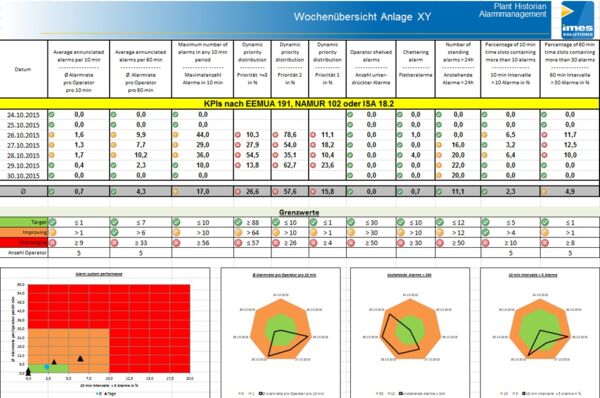
ISA 18.2 is an international standard for the design, implementation, and evaluation of alarm management systems in the process industry, which defines KPIs such as the average alarm rate per operator and alarm duration, among others. An alarm management system that supports automated reporting in accordance with ISA 18.2 provides these metrics without the need for manual analysis.
What is NAMUR NA102?
NAMUR NA102 is a recommendation issued by NAMUR, the user association for automation technology in the process industry, that specifies requirements for alarm management systems, particularly for German-speaking and European regions. It supplements ISA 18.2 with practical guidelines for evaluating alarm situations during ongoing plant operation.
What is EEMUA 191?
EEMUA 191 is a guideline published by the Engineering Equipment and Materials Users Association that outlines best practices for the design and operation of alarm systems, including measures to prevent alarm flooding. Along with ISA 18.2, it is considered one of the most frequently referenced international standards for alarm management.
What specific key performance indicators (KPIs) do these standards require?
Key KPIs include the average alarm rate per operator, alarm duration, the percentage of follow-up and false alarms, and an analysis of alarm frequency over specific time periods. An alarm management system that automatically provides these metrics significantly reduces the manual effort required to document compliance for auditors or regulatory agencies.
Features & Specifications
What is alarm flooding, and how does an alarm management system help prevent it?
Alarm flooding refers to a situation in which operators are confronted with so many alarms in a short period of time that it becomes nearly impossible to prioritize them effectively. An alarm management system provides clarity by organizing alarm lists according to priority and revealing the underlying patterns for future streamlining.
What are fluttering alarms and follow-up alarms?
Fluttering alarms are alarms that repeatedly go off and reset within a short period of time, usually as a result of fluctuations in measured values near a threshold. Follow-up alarms occur when an initial fault triggers a chain of subsequent alarms; analyzing them specifically helps distinguish the actual cause from mere symptoms.
How does duplicate detection work for alarms?
An alarm management system identifies alarms that occur multiple times within a very short time window—about one second—as duplicates and flags them accordingly. This prevents a single event from artificially inflating the alarm statistics and skewing the KPI analysis.
How are alarms forwarded from the system?
Alarms and events can be automatically forwarded via text message, email, phone, or directly to the digital shift log, ensuring that the appropriate personnel are notified even when they are away from the control room. This direct forwarding significantly reduces response times during critical events compared to a purely visual display in the process control system.
Technical Integration & Compatibility
To which process control systems can an alarm management system be connected?
Via OPC integration, Plant Historian 5 AM can be connected to virtually any common process control system, including Siemens Simatic PCS7, S7, and WinCC; Emerson DeltaV; Honeywell Experion; ABB Freelance and 800xA; Foxboro I/A Series, as well as safety-critical systems such as HIMA HiMax and Invensys Triconex. This enables the centralized monitoring of even heterogeneous plant environments involving multiple DCS vendors.
Benefits & Impact
How does alarm management benefit plant safety?
Alarm management enhances plant safety by providing transparency into alarm and event situations, thereby enabling faster, more informed decisions during critical moments. It has been proven to help prevent production losses, plant shutdowns, or—in the worst-case scenario—accidents resulting in injury, equipment damage, or environmental harm.
How does alarm management help reduce downtime?
By systematically analyzing alarm frequency and patterns, recurring causes of malfunctions can be identified and resolved before they lead to unplanned downtime. In one documented case, a customer was able to reduce downtime and noticeably improve process quality within a few months by reducing the number of alarms.
How is alarm management related to Overall Equipment Effectiveness (OEE)?
Fewer unnecessary alarms and faster response times to truly relevant malfunctions have a direct impact on equipment availability, one of the three factors in the OEE calculation. Alarm management thus provides one of the levers that can be used to systematically increase Overall Equipment Effectiveness.
What role does alarm management play as the foundation for alarm rationalization and MoC?
The metrics recorded in alarm management—such as alarm frequency, duration, and chattering behavior—form the fact-based foundation for subsequent alarm rationalization as well as for Management of Change (MoC) processes. Without this data, decisions regarding the reduction or adjustment of alarms would have to be based on experience rather than on reliable figures.
In which industries is alarm management used?
What are the benefits of alarm management, specifically in the chemical and petrochemical industries?
In the chemical industry, alarm management helps detect safety-related limit violations early on and automatically provides the metrics required by ISA 18.2 for audits and regulatory compliance. Documented implementations at one of the world’s largest chemical companies and at one of the largest refineries in the German-speaking world demonstrate its use in handling tens of thousands of daily alerts.
Is alarm management also used in power plants or wastewater treatment facilities?
Yes, alarm management is also used in power plants and wastewater treatment facilities to increase plant availability and help operating personnel prioritize alarm messages. Especially for safety-critical infrastructure, comprehensive documentation of alarms is also a prerequisite for regulatory compliance.

 Central Dashboard
 Plant Status
 E-mail Reports
 Reporting
 MOC
 Access Management
 PLC/PCS
 Alarm Rationalization