What is process data acquisition?
Process data acquisition refers to the systematic collection, storage, and analysis of measurement values generated during a production process—such as temperature, pressure, flow rate, or level. These values typically come from the process control system or directly from sensors and measuring devices and are archived in a central system so they can be analyzed later.
What is the difference between process data acquisition and process data archiving?
Process data acquisition refers to the process of collecting measured values, while process data archiving refers to the permanent, structured storage of this data over an extended period of time. In practice, these two steps are closely intertwined: Without continuous archiving, collected data cannot be analyzed retroactively, for example, for trend analyses or during customer audits.
How does process data acquisition differ from machine data acquisition (MDE) and operational data acquisition (BDE)?
Process data acquisition refers to continuous physical measurements from the ongoing process, while MDE tracks the status of individual machines (downtime, cycle time, malfunctions) and BDE captures higher-level operational metrics such as order and labor hours. All three systems can be combined, but they cover different levels of production transparency.
Which process parameters can be recorded using a process data acquisition system?
Typically, physical quantities such as temperature, pressure, flow rate, level, velocity, or humidity are recorded, as well as derived parameters such as consumption values or limit violations. Which parameters are relevant in each specific case depends on the respective production process and the associated quality requirements.
What analysis options does process data acquisition offer?
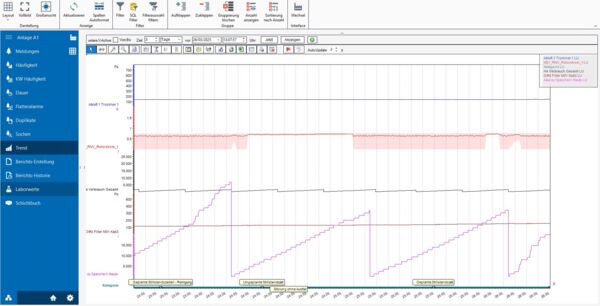
Plant Historian 5 PDA offers, among other features, trend displays that indicate limit violations, a measurement band function, and envelope curve displays for analyzing process behavior. Analyses can also be customized into trend groups and saved for future use.
What are calculation tags, and what are they used for?
Calculation tags link multiple recorded measurement values (tags) using mathematical operators and functions to create new, derived metrics. This makes it possible, for example, to calculation consumption values or composite process variables without the need for separate analysis software.
Can batch-specific analyses also be generated using process data acquisition?
Yes, Plant Historian 5 PDA enables batch-specific analyses and trend displays, allowing process data to be specifically assigned to a particular production batch. This is particularly relevant when quality deviations need to be traced back to a single batch, rather than considering the entire production period.
Can analyses be automatically generated as reports?
Yes, business-related documents can be automatically exported to Microsoft Excel and as PDFs, with predefined Excel templates automatically populated with the current actual values. This reduces the manual effort involved in reporting, such as for regular quality or management reports.
Which process control systems can be integrated with a process data acquisition system?
Through OPC integration, Plant Historian 5 PDA can be connected to virtually any common process control system, including Siemens Simatic PCS7 and S7, Emerson DeltaV, Honeywell Experion, ABB Freelance and 800xA, and Foxboro I/A Series. In practice, this independence from specific process control systems means that even heterogeneous plant environments involving multiple manufacturers can be analyzed using a single, centralized solution.
In which industries is process data acquisition used?
Process data acquisition is primarily used in the chemical industry, pharmaceutical manufacturing, the food industry, power plants, and the automotive supply industry. What these industries have in common is the need to detect process deviations early in order to prevent quality issues or equipment failures.
What are the benefits of process data acquisition in the chemical industry?
In the chemical industry, process data acquisition helps ensure continuous monitoring of critical process parameters such as temperature and pressure and enables the early detection of abnormal operating conditions before they lead to quality or safety issues. Comprehensive documentation also supports customer audits and communication with upstream and downstream suppliers.
What role does process data acquisition play in the energy sector?
In power plants and at energy utilities, process data acquisition is used to monitor and control energy generation and distribution, including the integration of renewable energy sources. A comprehensive database directly contributes to grid stability and the early detection of plant malfunctions.
How much does process data acquisition software cost?
The cost depends on the number of measurement points, the number of users, and the effort required to integrate the software into your existing system infrastructure, which is why it’s not possible to provide a reliable general estimate. For an assessment tailored to your facility, we recommend a no-obligation consultation with our sales team.