Basics & Classification
What are energy monitoring and energy controlling?
Energy monitoring refers to the continuous collection and presentation of energy consumption data, while energy controlling uses this data to generate key performance indicators, evaluate deviations, and thus provide the basis for targeted energy-saving measures. Together, these two components form the basis for systematic energy management in accordance with DIN EN ISO 50001.
What is the difference between energy monitoring and a comprehensive energy management system?
Energy monitoring provides transparency regarding consumption and key performance indicators, while an energy management system compliant with ISO 50001 also establishes processes, responsibilities, and continuous improvement measures within the company.
How does energy management differ from other Plant Historian modules, such as process data archiving?
Process data archiving records continuous physical process variables such as temperature or pressure, while energy management focuses specifically on consumption data, cost centers, and emissions metrics. Both modules can use the same plant connection but analyze the data for different purposes.
Standards & Eligibility
What does DIN EN ISO 50001 mean in the context of energy management software?
DIN EN ISO 50001 is the international standard for energy management systems, which requires companies to systematically track, evaluate, and continuously improve their energy consumption. Software that provides energy monitoring and control as the foundation for this process thus fulfills a key technical requirement of the standard.
What does BAFA recognition as eligible energy management software mean?
The Federal Office for Economic Affairs and Export Control (BAFA) has classified Plant Historian EM as eligible energy management software, which means that its purchase may generally be subsidized under certain funding programs. The specific requirements, subsidy rates, and application procedures are determined exclusively by the BAFA and should be verified directly with the BAFA or a funding consultant before making an investment decision.
Features & Specifications
What reporting features does the energy management software offer?
Plant Historian 5 EM provides consumption reports with freely configurable KPIs, such as totals and averages, as well as flexible, savable analysis options for custom reports. In addition, calculation parameters for variable reports and manually recorded consumption values can be incorporated.
What is meant by emissions monitoring in energy management software?
Emissions monitoring refers to the generation of a CO2 footprint based on recorded energy consumption data, enabling companies to document their CO2 emissions in a transparent manner. This is relevant for both internal sustainability goals and external reporting requirements.
How does cost center analysis work in energy management?
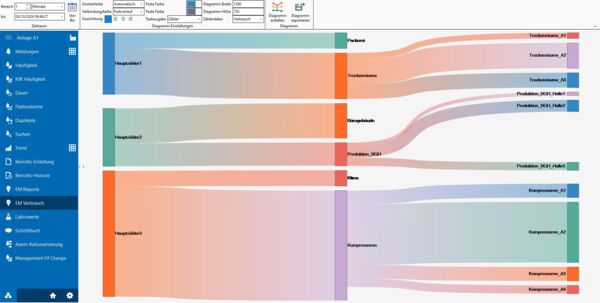
Meters can be specifically assigned to individual cost centers, allowing energy consumption and costs to be analyzed not only on a company-wide basis but also broken down by department, plant component, or process step. This enables a more targeted identification of savings potential than a simple analysis of total consumption.
How does the validation and alerting process for balancing groups work?
Metering data is validated online, and alerts are automatically triggered when readings exceed or fall below defined thresholds, ensuring that deviations in balancing groups are detected early. This prevents erroneous metering data from being included in consumption analyses without being noticed.
Technical Integration & Compatibility
Which interfaces can be used to collect energy data?
Connectivity is standardized via M-Bus to TCP/IP, Modbus connections (e.g., via RS485), and 4–20 mA or 0–20 V signals to TCP/IP, either via OPC or Modbus. This allows both traditional energy meters and analog measurement points to be integrated centrally.
Which process control systems can the energy management software be integrated with?
Plant Historian 5 EM can be integrated with common process control systems via standardized OPC connectivity, including Siemens Simatic PCS7 and S7, Emerson DeltaV, Honeywell Experion and PHD, ABB Freelance and 800xA, and Foxboro I/A Series. This enables the centralized analysis of even heterogeneous control system landscapes for energy management purposes.
Introduction & Implementation
Can existing data sources and meters be integrated into the system?
Yes, the integration of existing data sources is a core feature of the system, so existing meters and measurement points are not replaced but are incorporated into the central analysis. This reduces the investment costs compared to completely overhauling the measurement infrastructure.
Is the solution scalable even as the number of measurement points or systems grows?
Yes, as a centralized, company-wide solution, additional PLS/PLC server connections can be added later without having to rebuild the existing structure. This makes it suitable for a phased rollout across multiple locations.
Benefits & Impact
What are the economic benefits of energy monitoring?
By identifying instances of excessive consumption and promptly implementing corrective measures, energy costs can be reduced in the long term, as opportunities for optimization are specifically identified rather than merely assumed. Automated reporting also reduces the manual effort required for cost control.
How does energy management contribute to sustainability and CO2 reduction?
By monitoring emissions and assessing efficiency based on key factors, CO2 emissions can be documented in a transparent manner and reduced in a targeted way, rather than simply estimated as a general figure. This supports both internal corporate sustainability goals and external reporting requirements.
What reputational benefits does a certifiable energy management system offer?
An energy management system aligned with ISO 50001 enhances the company’s public image among customers, suppliers, and investors, who are increasingly demanding proof of energy efficiency and sustainability. This can be an increasingly important competitive factor in bids or supplier audits.